Building Foundations, One Shift at a Time
PLAYchitecture Coaching
Play isn’t just a break from learning—it is the blueprint for how the developing mind learns to think, feel, and problem-solve.
Our coaching service is a hands-on, collaborative partnership to help you succeed in your classroom and in your daily interactions. We connect complex neuroscience with everyday play, helping you intentionally build a child’s mind through both structured and unstructured play.
“Your vision, my approach, the final design.”
Pedagogy of Presence
The student’s regulation begins with the presence of the adult. The Pedagogy of Presence is a format of experiential workshops designed to help teachers, caregivers, and early childhood professionals recognize, understand, and regulate their own emotional and bodily states before attending to children’s needs.
The program integrates gentle movements inspired by Tai Chi, mindful breathing, body awareness, regulation pauses, and co-regulation strategies applicable to the educational context.
Professionals learn to identify how stress, bodily tension, fatigue, and emotional overload can influence their decisions, communication, and responses to children’s behavior. Through accessible and adaptable practices, they develop resources to regain calm, respond with greater intention, and become a more stable and emotionally available presence for their students.
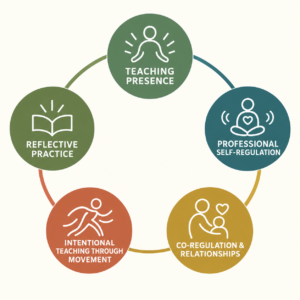
It is a professional development program that uses principles and movements inspired by Tai Chi to strengthen teacher self-regulation, co-regulation, and intentional teaching.
The program is based on a fundamental premise: the educator’s physical and emotional state is part of the learning experience. Breathing, posture, tone of voice, rhythm, and the way the child is approached can influence emotional security, participation, and the classroom climate.
Through experiences of conscious movement, analysis of educational situations, reflection, and planning, participants learn to move from automatic reactions to more observant, sensitive, and intentional pedagogical responses.
The purpose is not to train Tai Chi instructors or present movement as treatment. The purpose is to help educators use body awareness as a professional tool to observe better, communicate more clearly, accompany emotions, set respectful boundaries, and make informed pedagogical decisions.
No previous experience in Tai Chi, physical activity, or contemplative practices is required.
Why Tai Chi for educators?
Tai Chi combines slow movements, breathing, attention, balance, and body awareness. In this program, it serves as an accessible practice for well-being and self-regulation, not as medical or psychological treatment.
These principles can help the educator practice:
- The intentional slowing of the pace.
- The connection between breath and movement.
- The awareness of posture and muscle tension.
- The balance between stability and flexibility.
- Attention to the present moment.
- The transition between activation and calm.
- The deliberate response instead of the automatic reaction.
- Recovery after a stressful experience.
The practices are brief and functional. Some can be done standing, sitting, or with adapted movements. They can also be used before the day starts, during transitions, after challenges, or at the end of the day.
Objectives of the workshops
Upon completing the workshop, participants will have opportunities to:
- Understand the difference between self-regulation, co-regulation, and behavior management.
- Recognize how your emotional and physical state can influence the classroom climate.
- Identify personal signs of stress, activation, tension, or overload.
- Practice basic Tai Chi movements and conscious breathing exercises.
- Use brief regulation pauses before responding to difficult situations.
- Develop strategies to maintain emotional connection while setting boundaries.
- Apply co-regulation principles during conflicts, transitions, and challenging behaviors.
- Create a personal regulation plan that can be incorporated into the professional routine.
- Promote a calmer, more sensitive, predictable, and receptive educational environment.
- Model healthy practices of body awareness and emotional management for the children.
Methodology
The workshops are conducted using an active, reflective, and participatory approach. Depending on the selected duration, they may include:
- Demonstrations of Tai Chi movements.
- Guided practices of breathing and body awareness.
- Individual and group exercises.
- Analysis of real classroom situations.
- Professional reflection activities.
- Discussions on self-regulation and co-regulation.
- Practice responses to challenging behaviors.
- Development of personal plans.
- Tracking materials for daily practice.
The workshop environment is respectful and non-competitive. The movements can be modified according to the characteristics, abilities, and needs of each participant.
Conceptual Framework
Five Pedagogical Pillars
Who is it aimed at?
The program can be adapted for:
- Early childhood educators.
Childcare providers. - Special education teachers.
- Teacher assistants.
- Educational directors and coordinators.
- Early intervention professionals.
- Home visitors.
- Human services professionals.
- University education students.
- Interdisciplinary teams working with children and families.
- Parents, mothers, and caregivers will be involved through a family version.
Expected benefits
Participants will be able to develop:
- Greater awareness of your personal stress signals.
- Strategies to reduce impulsive responses.
- Greater ability to pause before intervening.
- More conscious use of the body, breath, and voice.
- More intentional responses to difficult situations.
- Greater understanding of behavior as communication.
- Co-regulation tools applicable to the classroom.
- Brief practices to regain balance during the day.
- Greater sensitivity toward individual and sensory differences.
- A shared language about well-being and regulation within the team.
The workshops do not promise to eliminate stress or replace medical or mental health services. Their purpose is to strengthen educators’ body awareness, professional well-being, and relational practices.
What distinguishes this workshop?
Pedagogy of Presence connects the educator’s well-being with their professional practice. It does not present regulation solely as a technique that the teacher applies to the child. It acknowledges that the adult’s state is part of every educational interaction.
The workshop is distinguished by integrating:
- Tai Chi and conscious movement.
- Body and emotional self-regulation.
- Adult-child co-regulation.
Reflection on practice. - Strategies applicable to real-life situations.
- Adaptations for different abilities and contexts.
- Respect for cultural, linguistic, and sensory diversity.
- Emphasis on connection before, during, and after setting boundaries.
Workshop Principles:
Regulation begins with awareness
We can only intentionally modify a state after we have recognized it.
The body also participates in teaching.
Posture, breathing, movement, facial expression, and tone of voice are part of educational communication.
Calm cannot be imposed.
The educator creates conditions of safety, connection, and predictability that can help the child to organize themselves.
Co-regulation does not mean permissiveness.
It is possible to set clear boundaries and protect safety while maintaining a respectful relationship.
Teacher well-being is a shared responsibility.
Individual practices are important, but organizational support, reasonable timeframes, resources, and a respectful work culture must accompany them.
The practice must be accessible.
Each participant can adapt the movements according to their body, comfort, and ability.
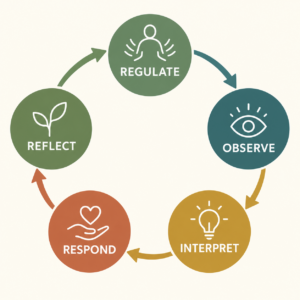
The child’s socio-emotional regulation does not begin with an instruction to calm down. It begins with the presence of an adult who can recognize their state, regain balance, and respond intentionally.
Pedagogy of Presence offers Tai Chi, breathing, and body awareness workshops to help education professionals strengthen their self-regulation and become a source of safety, connection, and co-regulation for children.
Bring Pedagogy of Presence to your organization:
Each workshop can be adapted to the needs of schools, early childhood education centers, universities, community programs, and interdisciplinary teams. The experiences are available in both in-person and professional development series formats.
Request information about duration, content, institutional adaptation, and availability. The workshop includes up to 6 modules, while the curriculum includes up to 8 modules.
“Co-regulation does not begin with words. It begins with the state from which we approach the child.”
RECOGNIZE, SELF-REGULATE, CO-REGULATE